
Part I: Be the Captain of Your Own Score - Navigating the CDP Scoring Iceberg
CDP Scoring Part I – Above the Waterline
July 2026
By Colton & Brittany
If you’ve ever opened the CDP scoring guidance only to feel immediately overwhelmed, you’re not alone. CDP scores may look like simple letter grades, but they reflect a layered set of criteria along with scoring thresholds, weighting, and sector-specific rules.
In other words, for CDP, “85 out of 100” does not equal a “B”.
Whether driven by investors, customers, or internal goals, sustainability professionals are often under pressure to improve or maintain their company’s CDP score. That pressure can be frustrating. CDP’s scoring system is structured, but not always intuitive, even for experienced sustainability professionals. To make the mechanics easier to see — and easier to navigate — PSC developed the CDP Scoring Iceberg.
Scope note: This blog and the CDP Scoring Iceberg focus specifically on CDP’s corporate reporting and scoring framework, not disclosures for cities, states, or regions.
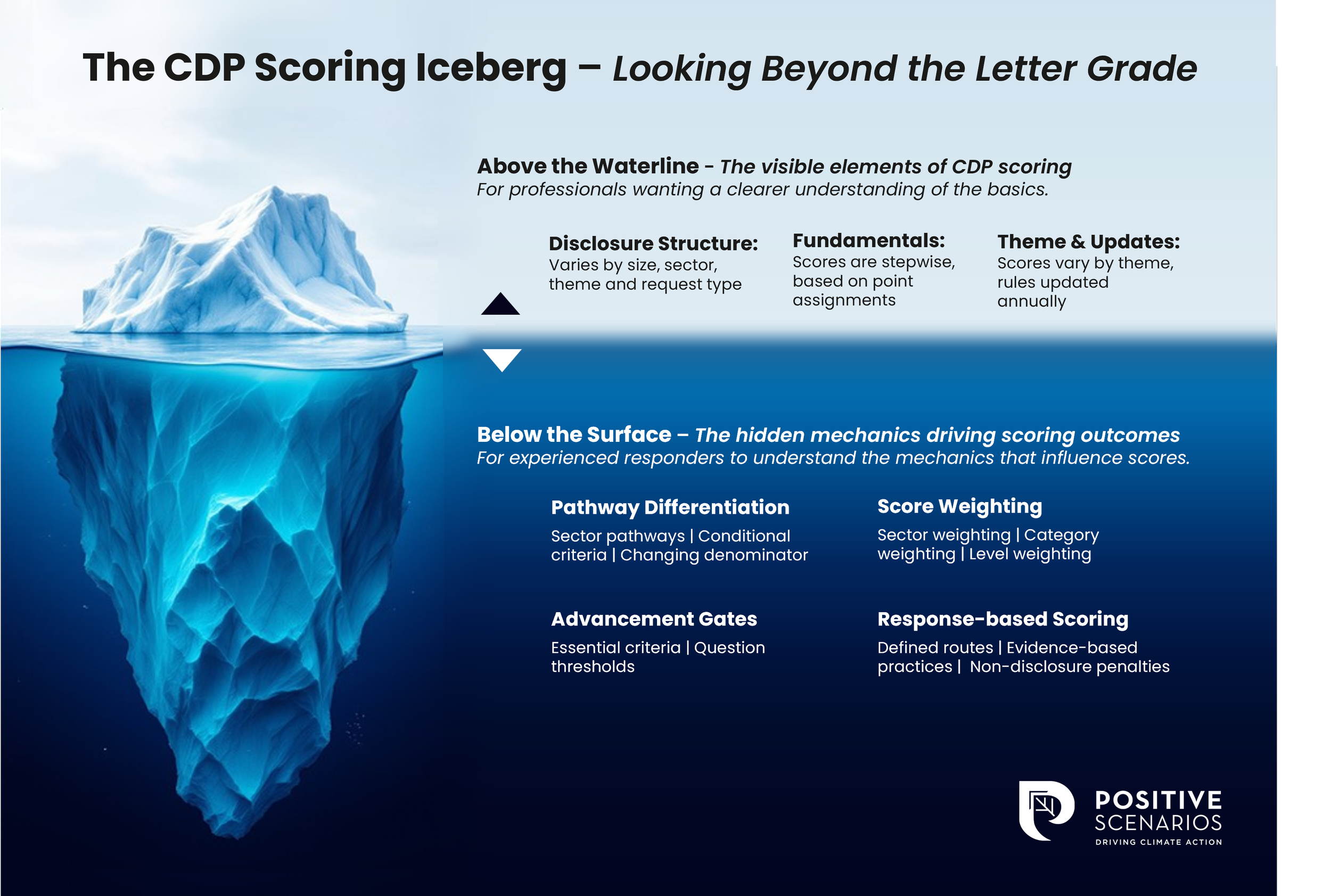
The CDP Scoring Iceberg divides scoring into two parts:
Part I – Above the Waterline: For sustainability professionals who are new to CDP scoring or want a clearer understanding of the basics. Covers scoring concepts that are easier to see and understand.
Part II – Below the Surface: For more experienced CDP responders looking to understand the deeper scoring mechanics. Covers concepts that are more opaque and nuanced.
The good news is that CDP scoring is not arbitrary. The scoring framework is a complex but structured system designed to reward transparency, consistency, and progress. Once you understand how to navigate it, CDP scoring can become more than a letter grade – it can become a roadmap for meaningful environmental progress.
While stakeholders may focus on the letter grade, the broader goal should be stronger climate action and greater organizational impact. The score can help validate progress and identify improvement opportunities, but it should not be the only measure of success.
This article focuses on Part I: the visible elements above the waterline. Part II will go below the surface to explore the deeper mechanics that shape final score outcomes.
Disclosure Structure
Before diving into CDP scoring, it helps to understand the questionnaire structure. The type of questionnaire a company receives, the themes it discloses against, and the modules it completes all shape what gets scored and how.
Integration – In 2024, CDP combined all disclosures into one, integrated questionnaire for the first time.
Note: Prior to 2024, companies completed separate questionnaires for each environmental theme.Themes – Within the integrated questionnaire, there are six environmental themes: three that currently receive public scores — climate change, water security, and forests — and three that are included for disclosure but are not currently scored — biodiversity, plastics, and oceans (new in 2026).
Note: Companies are not always requested to respond to all of them. For example, in 2025 less than 16% of companies responded to all three scored themes.
Types –There are two corporate questionnaires, the full questionnaire and the significantly shorter SME questionnaire (for small- and medium-sized entities).
Note: In 2025, roughly half of corporate responders disclosed through the SME questionnaire.Modules – The questionnaire is structured in a series of modules. The full corporate questionnaire is structured across 13 modules, while the SME questionnaire contains eight SME-specific modules.
Note: Some modules will apply to multiple environmental themes. For example, in the full corporate disclosure, questions in modules 1-6, 12 and 13 may be used to score the climate change and water security themes, while module 9 only relates to water security.Supply chain – Companies may receive supply chain requests from customers, which can add customer-specific data points, including questions about emissions allocated to the requesting customer.
Scoring Fundamentals
On the surface, CDP scoring looks simple: companies answer questions, earn points, and receive a letter grade. In practice, the mechanics are more layered. To understand what a CDP score really reflects, it helps to start with the basics: scoring levels, point assignments, and stepwise progression.
Scoring levels – Submitted questionnaires are scored from D- to A, with each tier reflecting a different level of disclosure maturity. CDP’s framework progresses through:
Disclosure (D-/D): rewards completeness and transparency
Awareness (C-/C): reflects understanding of environmental impacts, risks, and opportunities.
Management (B-/B): requires evidence of policies, processes, targets, and accountability
Leadership (A-/A): reflects best practice, including robust strategy, credible targets, and performance management.
Note: Achieving leadership level is rare. In 2025, only 5% of responders were on the A List.
Point assignments – Each question is awarded points based on the relevant CDP scoring guidance. Some questions are worth far more points than others.
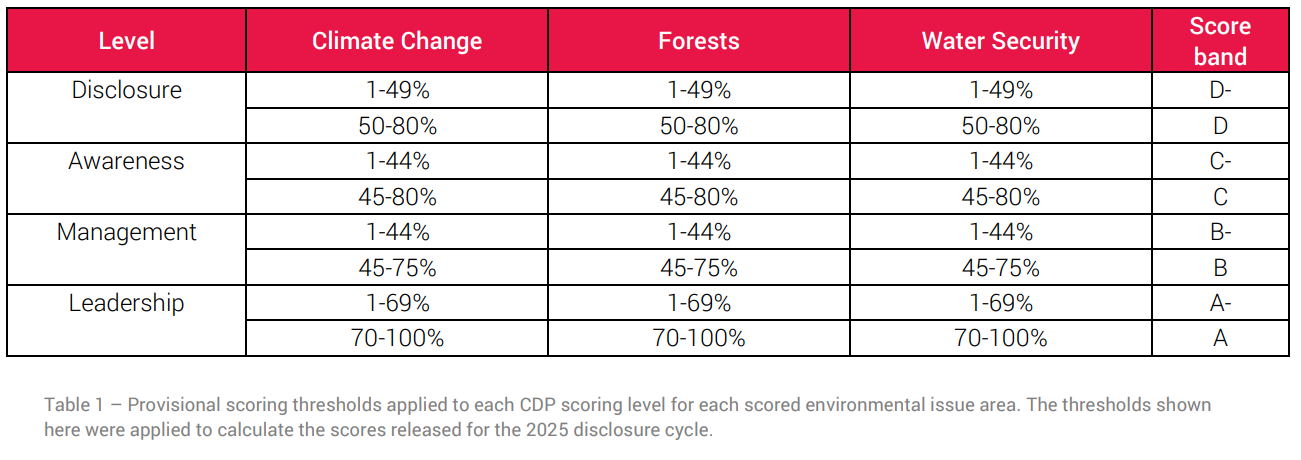
Note: At the Disclosure and Awareness levels, scores are assigned based on the percentage of points awarded out of points available; however, scoring at the Management and Leadership levels is calculated differently. More on this in part II.Stepwise scoring – A company must meet a sufficient percentage of available points at one scoring level before progressing to the next. In practice, this means a company cannot compensate for missing information by providing a few strong Leadership-level responses.
Note: The threshold for advancing changes each year based on the CDP responder pool, but below are the scoring thresholds applied to calculate the scores released for the 2025 disclosure cycle.
www.cdp.net | @CDP
Scores and Updates
CDP scores are assigned by environmental theme, but additional reporting contexts such as supply chain requests can affect how responses are evaluated. Additionally, CDP updates its questionnaire and scoring materials each year, so scoring expectations can shift from one disclosure cycle to the next.
Theme scoring – CDP assigns separate scores for each environmental theme (e.g., your Climate Change and Water Security scores will be separate).
Note: While scores are separate, CDP does use some of the same information when calculating scores for each theme.
Supply chain scoring – Supply chain responses are not issued as a standalone public “supply chain score.” Instead, customer-requested questions can influence what the requester sees and may affect the company’s theme scores where those questions are included in the scored methodology.
Commodity scoring – For Forests, specifically, in addition to one final score, there are also sub-scores for each commodity the company provided information on.
Annual updates – CDP updates its questionnaire and scoring materials each year. These updates are published in advance of the disclosure cycle and can affect how a company’s response is scored from year to year.
Note: Changes can be small or large. For example, CDP’s 2026 cycle expands forests coverage to include cocoa, coffee, and rubber as scored commodities.
The visible parts of CDP scoring may look straightforward, but they are more than administrative details. They establish the foundation for stronger disclosure and help companies understand where their current practices align with recognized sustainability best practices — and where there is room to improve.
It is important to remember that the score is not the destination. Used well, it can serve as one signal among many to help companies strengthen systems, improve evidence, and make more meaningful environmental progress.
In Part II, we’ll go below the waterline to examine the deeper mechanics that can materially affect score outcomes, including pathway differentiation, stage gates, score weighting, and scoring routes and penalties.